
That fresh coat of “weatherproof” masonry paint applied decades ago might actually be the very thing slowly dissolving your property’s historic stone. It’s a common anxiety for owners across the UK; you want the exterior to look its best, yet the fear that paint stripping from listed building facade masonry will cause irreversible erosion is entirely valid. Since we established our business in November 2000, we’ve seen first-hand how trapped moisture behind non-breathable “plastic” coatings can lead to catastrophic masonry failure.
This guide will show you how to safely remove these damaging layers whilst restoring the essential breathability of the stone. We’ll explore the technical nuances of superheated steam systems like Thermatech (often referred to by the industry term DOFF), the legalities of UK heritage regulations, and why a conservation-led approach is the only way to protect your investment. You’ll also learn which methods to avoid, such as why superheated steam should never be used on interior woodwork, ensuring your restoration project meets the highest professional standards and preserves the structural integrity of your heritage property.
Key Takeaways
- Understand the “moisture trap” effect and why modern plastic-based coatings are fundamentally incompatible with breathable historic masonry.
- Learn the safest techniques for paint stripping from listed building facade stone using superheated steam to prevent irreversible surface erosion.
- Clarify the differences between the Thermatech and DOFF systems to ensure you select the most precise cleaning method for your specific property.
- Navigate the complexities of UK heritage regulations, including the essential steps for securing Listed Building Consent before commencing work.
- Gain professional insight into managing hazardous lead-based paints and why certain surfaces, such as interior wood, require a different conservation approach.
The Hidden Risks of Modern Paint on Listed Building Facades
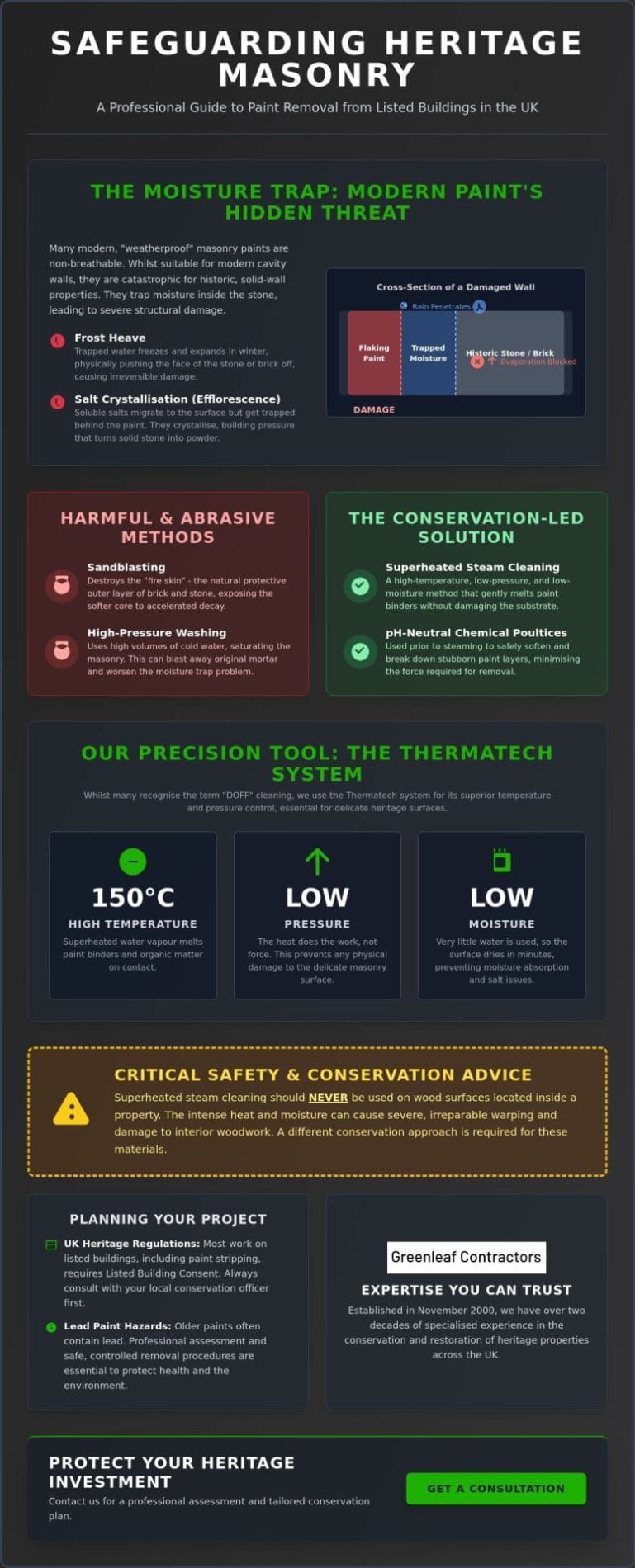
The fundamental issue with modern paints on historic structures is their lack of permeability. Most 19th and 20th-century oil or plastic-based paints were designed to be “washable” and “waterproof,” which sounds ideal but is actually a death sentence for historic masonry. Whilst modern properties use cavity walls to stay dry, listed buildings rely on the natural movement of moisture through the stone or brick. When paint stripping from listed building facade surfaces is delayed, these “waterproof” layers act as a barrier, sealing moisture inside the structural core. Having been in business since November 2000, we’ve diagnosed hundreds of facades where inappropriate coatings have caused significant delamination.
This creates the “moisture trap” effect. Water vapour from inside the building or rain entering through micro-cracks cannot evaporate. Instead, it accumulates behind the paint film. During winter, this liquid water freezes and expands, causing “frost heave” where the face of the stone is physically pushed off. You might also see efflorescence; these are soluble salts that crystallise beneath the paint, creating enough pressure to turn solid stone into powder. The result isn’t just an aesthetic mess of flaking paint; it’s a direct threat to the building’s structural integrity and the health of the interior environment.
Identifying Damaging Coatings: From Limewash to Plastic
Traditional coatings like limewash are sacrificial; they wear away over time and allow the stone to breathe. In contrast, modern masonry paints often feel rubbery or “plasticky” to the touch. If you notice “blown” brick faces or mortar joints that have turned to dust behind a layer of paint, your building is likely suffering from a lack of breathability. In the context of historic masonry, breathability is the ability of a material to allow water vapour to pass through its pores while remaining structurally sound. Choosing the right paint stripper or cleaning method is the first step in reversing this damage and restoring the facade’s natural behaviour.
The Heritage Impact: Preserving Northern Stone Integrity
Properties across Leeds, York, and Hull often feature porous Yorkstone or delicate limestones that are particularly susceptible to moisture damage. We’ve seen many cases where well-meaning owners have tried aggressive “sandblasting” to remove paint, only to find they’ve destroyed the “fire skin,” which is the naturally hardened outer layer of the brick or stone. Once this skin is gone, the softer core is exposed to the elements, accelerating decay. This same principle applies when cleaning Bath stone buildings, where the porous limestone is especially vulnerable to abrasive techniques that strip the protective face and expose the softer core beneath. Our approach to stone cleaning avoids these abrasive risks, focusing instead on gentle, conservation-led techniques that respect the unique geology of Northern England.
Conservation-Approved Methods: Thermatech and Chemical Stripping
Most property owners approaching us for paint stripping from listed building facade work are already familiar with the term “DOFF” cleaning. It’s a widely recognised industry standard for superheated steam. However, for the high-precision requirements of historic masonry, we prefer the Thermatech system. It offers a level of temperature and pressure control that’s essential when you’re dealing with fragile substrates. Our primary approach often involves a “soften and steam” workflow. We apply pH-neutral chemical poultices to break down the resilient binders in modern paints, followed by a gentle rinse using superheated steam.
The science behind this is straightforward but effective. By heating water to 150°C, the system creates a high-temperature vapour that melts paint binders almost instantly. Because the heat does the heavy lifting, we can keep the pressure extremely low. This ensures there’s no mechanical damage to the stone or brickwork. This methodology aligns with official government guidance on paint and historic buildings, which prioritises the preservation of the building’s original fabric over aggressive, fast-paced removal. The same low-pressure, high-heat principles that protect painted masonry are equally critical when considering how to clean limestone facades, where the delicate calcite structure demands minimal mechanical force to avoid irreversible surface erosion.
Thermatech vs. Traditional Pressure Washing
Standard pressure washing is often the enemy of listed buildings. It uses high volumes of cold water at high pressure, which can saturate the stone and blast away original mortar. Thermatech is different. It’s a low-moisture, high-heat approach. Since we use very little water, the masonry dries much faster. This rapid drying prevents the moisture traps that lead to salt crystallisation and frost damage. If you’re unsure which method suits your property, our specialist stone cleaning services can provide a tailored assessment based on your specific stone type.
Critical Safety: Why Steam is for Facades, Not Internal Timbers
We provide a firm warning to all our clients: never use superheated steam on structural wooden beams inside a property. Whilst it’s a miracle for stone facades, the intense heat and moisture can be devastating for interior timber. It can cause ancient wood to warp, split, or even trigger fungal growth. For those looking to restore interior features, we suggest reviewing our safe wooden beam cleaning methods, which utilise dry, gentle abrasive techniques instead.
Planning Your Project: Regulations, Lead Safety, and Expertise
Before any physical work begins, you must secure Listed Building Consent from your local planning authority. Carrying out unauthorised alterations to a protected property is a criminal offence in the UK, and paint stripping from listed building facade masonry usually falls under “material change.” We always recommend starting with “trial patches” in a discreet area. This diagnostic phase allows us to determine the most effective, least intrusive cleaning method for your specific stone type, ensuring we follow the “gentlest means possible” principle found in the National Park Service guidance on paint removal from historic masonry. The same conservation-first philosophy underpins our approach to cleaning Bath stone buildings, where the delicate porous limestone demands equally careful assessment before any treatment begins.
Since we established Surfprep in November 2000, we’ve positioned ourselves as a safeguard against “cowboy” contractors who rely on aggressive abrasives. Over 25 years of experience has taught us that every facade has a unique history. What worked on a gritstone terrace in Bradford might not be appropriate for a limestone townhouse in York. For properties featuring exposed limestone, understanding how to clean limestone facades correctly is essential, as the stone’s porous calcite composition makes it far more reactive to both chemical treatments and mechanical pressure than harder sandstones or granites. Our tenure in the industry ensures we provide the technical grit required for the job without sacrificing the delicate touch needed for heritage conservation.
Navigating UK Lead Paint Regulations
Buildings constructed before the 1960s almost certainly contain lead-based paints. The Health and Safety Executive (HSE) mandates strict protocols for lead dust containment and the safe disposal of stripped waste. One of the primary reasons we utilise superheated steam is safety. The Thermatech system naturally suppresses dust by keeping the paint waste damp and contained, which significantly reduces the risk of toxic particles becoming airborne compared to traditional dry scraping or sanding methods.
Choosing a Specialist Heritage Contractor
When vetting a contractor, ask about their understanding of surface preparation standards. An industrial specialist might discuss “Sa 2.5” (a standard for near-white metal), but a heritage professional knows that such aggression would ruin porous stone. You need a team that applies “gentle” logic to every square metre. If you require a site survey in the North of England, you can contact our restoration team today. For more localised advice, see our guide on Professional Brick Cleaning in Leeds.
Securing the Future of Your Historic Masonry
Restoring a heritage property is about more than aesthetics; it’s a technical commitment to the building’s survival. By removing impermeable coatings, you allow the masonry to breathe and prevent the moisture-trap cycle that leads to structural decay. Navigating the complexities of lead-paint hazards and UK heritage regulations requires a contractor who understands that “gentle” isn’t just a suggestion; it’s a requirement for long-term preservation.
Successful paint stripping from listed building facade masonry requires a balance of high-temperature precision and low-pressure care. Since we were established in November 2000, we’ve spent over two decades perfecting these conservation techniques. As specialists in Thermatech technology (the precision alternative to DOFF systems), we’re approved for Grade I and II listed building restoration. Just remember our expert advice: whilst superheated steam is the gold standard for facades, it should never be used on interior wood surfaces.
Ready to restore your property’s natural beauty? Request a Specialist Facade Survey to discuss your project with our experienced team. Your listed building is a piece of history; let’s ensure it’s protected for the next generation.
Frequently Asked Questions
Do I need Listed Building Consent for paint stripping?
Yes, you almost certainly require Listed Building Consent before commencing any paint stripping from listed building facade masonry. Removing paint is considered a material alteration that affects the building’s character and historical significance. Whilst the application for consent itself is free of charge in England and Wales, you should budget between £300 and £800 for a specialist heritage impact statement to support your proposal and ensure the local authority is satisfied with your chosen method.
Is superheated steam cleaning the same as a DOFF machine?
Thermatech and DOFF both utilise superheated steam at low pressure to remove coatings, but they are produced by different manufacturers. Whilst “DOFF” is a widely recognised industry term that many customers use, we prefer the Thermatech system for its precision temperature and pressure control. It’s important to remember our professional safety guidance: whilst this technology is the gold standard for stone facades, superheated steam should never be used on structural wooden beams located inside a property.
Can you remove modern masonry paint from old soft red bricks?
We can safely remove modern “plastic” paints from soft red bricks without damaging the delicate “fire skin” of the masonry. The process involves using a pH-neutral chemical softener to break down the paint binders, followed by a gentle rinse with superheated steam at very low pressure. This conservation-led approach prevents the aggressive mechanical damage caused by sandblasting, which would otherwise leave the porous brick core exposed to rapid weather erosion.
What happens if lead paint is found on my building facade?
If lead paint is detected, the removal process must comply with strict Health and Safety Executive (HSE) regulations for containment and disposal. Our Thermatech system is particularly effective here because the superheated steam naturally suppresses toxic dust, keeping the waste damp and easy to collect safely. This is a significantly safer alternative to dry scraping or sanding, which creates dangerous airborne particles that can harm both the environment and the public.
How much does it cost to strip paint from a listed building?
Total project costs depend on the number of paint layers and the condition of the underlying stone, but you must factor in UK heritage standards. Specialist labour rates for heritage-accredited tradespeople typically range from £300 to £540 per day. If your property is in a Conservation Area with an Article 4 Direction, you may also need to pay a planning permission fee of £206 for exterior alterations, alongside costs for scaffolding and specialist waste disposal.
How long does the paint stripping process take for a standard townhouse?
A typical townhouse facade usually takes between one and two weeks to complete, depending on the complexity of the architectural details and the resilience of the paint. We’ve been in business since November 2000 and have found that rushing the process is never an option for listed properties. We always begin with trial patches to establish a realistic timeline, ensuring the masonry is treated with the care required to meet heritage standards.
