
That standard pressure washer in your garage might seem like the most efficient tool for the job, but when it comes to heritage stonework, it’s often the quickest way to cause irreversible damage. We understand the frustration of watching a beautiful building disappear under a layer of soot or organic growth, yet many owners are understandably unsure how to clean limestone facades without eroding the delicate surface or upsetting local conservation officers. It’s a delicate balance between achieving a fresh appearance and preserving the historical integrity of the masonry.
In this specialist guide, we’ll share the safest, most effective methods for restoring limestone whilst ensuring the stone remains breathable. Since we established our business in November 2000, we’ve championed techniques like the Thermatech superheated steam system (widely recognised as DOFF) and our gentle damp sand jet machine. We’ll walk you through the technical differences between indoor and outdoor applications, explaining why we avoid certain aggressive chemicals and how to achieve a finish that satisfies both your aesthetic goals and strict heritage standards. Whether you’re dealing with a private residence or a commercial landmark, our goal is to provide a clear, professional path to a clean, preserved facade.
Key Takeaways
- Understand why limestone’s porous, sedimentary nature makes it uniquely vulnerable to acid rain and the formation of damaging gypsum “black crust” in urban environments like Leeds and Manchester.
- Learn how to clean limestone facades using gentle, temperature-controlled methods like Thermatech superheated steam (DOFF) to preserve the stone’s delicate surface and structural integrity.
- Identify the essential differences between outdoor damp cleaning processes and the low-pressure dry grit blasting required for internal restoration to manage moisture effectively within a property.
- Discover why a professional assessment is vital for heritage buildings, including the “Expert Admission” regarding when stone may be too friable for certain cleaning techniques.
Why Limestone Facades Require a Specialist Cleaning Approach
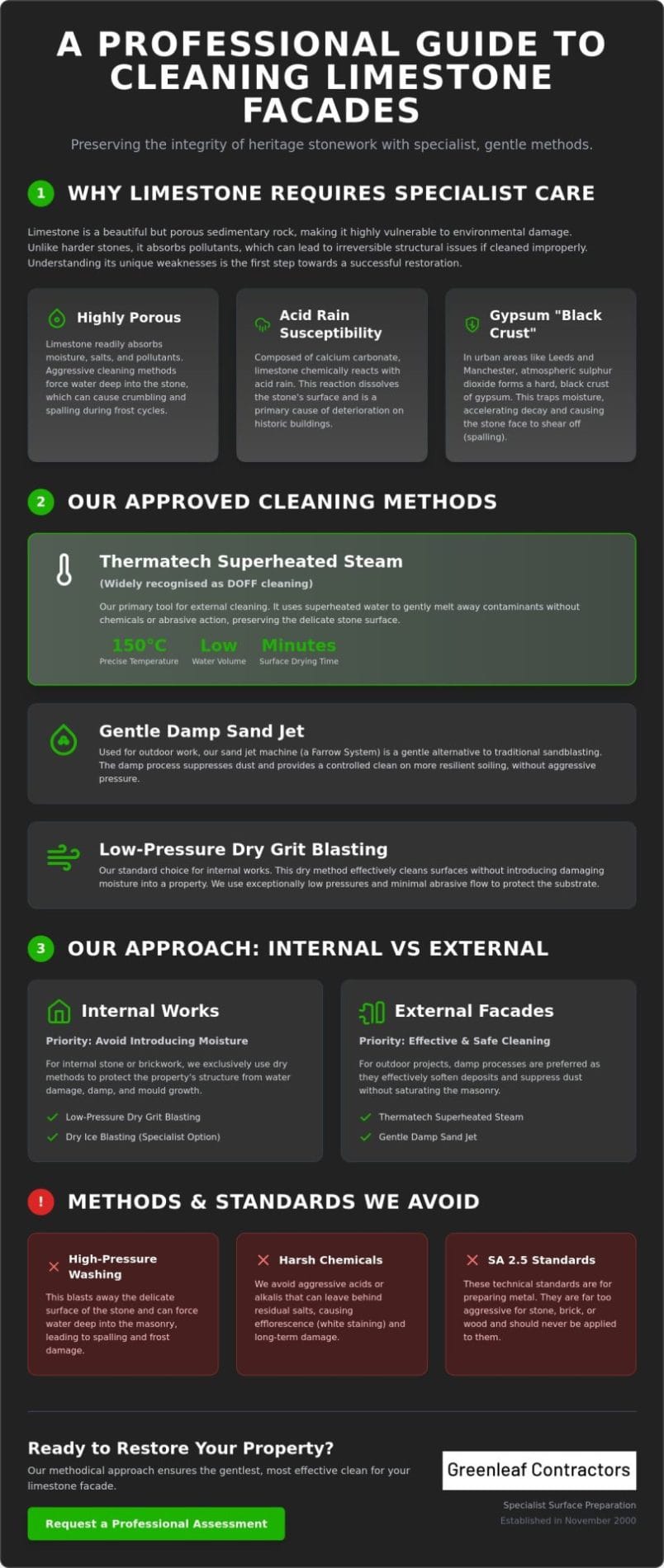
Limestone is a beautiful but temperamental material. To understand what is limestone, we must look at its origins as a sedimentary rock composed largely of calcium carbonate. This chemical makeup makes it highly porous and particularly susceptible to the corrosive effects of acid rain. Unlike harder granites or modern masonry, limestone absorbs moisture and pollutants. This often leads to deep-seated structural issues if the wrong cleaning methods are applied. Understanding how to clean limestone facades correctly is the difference between a successful restoration and permanent masonry damage.
In Northern cities like Leeds and Manchester, we often see a phenomenon known as “black crust.” This isn’t just surface dirt; it’s a chemical reaction where atmospheric sulphur dioxide reacts with the calcium carbonate in the stone to form gypsum. This phenomenon is particularly prevalent amongst historic buildings in Northern city centres. The crust traps moisture and salts behind it, leading to “spalling” where the face of the stone eventually shears off. We view stone cleaning as a restoration process that must prioritise vapour permeability. The stone has to “breathe” once the contaminants are removed, or you risk trapping moisture that will cause the stone to crumble from within during the next frost cycle.
Aggressive pressure is the primary enemy of soft stone restoration. Using a standard high-pressure washer can force water deep into the pores or literally blast away the delicate surface detail of the masonry. Our approach, which we’ve refined since establishing our business in November 2000, focuses on controlled, low-pressure systems. These preserve the stone’s integrity whilst achieving a thorough clean. Knowing how to clean limestone facades requires a respect for the material’s age and its specific environmental challenges.
Identifying Common Contaminants: Carbon, Lichen, and Soot
Before any work begins, we must differentiate between organic growth and atmospheric deposits. Moss and algae thrive in damp, shaded areas, often leaving green or orange stains. However, the heavy black staining seen on Portland stone in city centres is usually carbon-based soot. Identifying whether you have Bath stone, Portland stone, or a local variety is vital. A chemical reaction that turns stone black requires a far more nuanced response than simple organic growth. Misidentifying the contaminant often leads to ineffective or damaging results, which is why a professional assessment is always our first step. The same careful identification process applies when learning how to clean stone steps, where persistent black spot lichens and algae present similar challenges on Yorkstone and Portland stone entrances.
Professional Methods for Cleaning Limestone Facades Safely
Before we begin any restoration, we conduct a thorough site assessment. This isn’t a mere formality; it’s essential for protecting the substrate and determining the exact nature of the contaminants. We always perform test patches on inconspicuous areas to verify the result before proceeding with the full facade. This methodical approach aligns with international NPS guidelines for cleaning historic masonry, which advocate for using the gentlest means possible. Our preference is to avoid harsh chemicals that can leave behind residual salts or cause efflorescence. Instead, we rely on thermal energy and low-pressure physical action to achieve a restorative finish.
A critical part of our strategy is managing moisture. For outdoor projects, we prefer damp processes that suppress dust and soften deposits. However, for internal works, we pivot to dry methods to avoid introducing water into a property’s structure. In these cases, we use traditional dry grit blasting at exceptionally low pressures and low abrasive rates. This is a far cry from industrial cleaning; we explicitly avoid technical standards like Sa 2.5, as these are meant for metal and would be far too aggressive for stone. If you’re planning a project and need advice on the right approach, you can request a professional stone cleaning assessment from our team.
Thermatech Superheated Steam (DOFF) Cleaning
Our primary tool for external facade restoration is the Thermatech system. Whilst many clients recognise this technology as DOFF cleaning, Thermatech is our preferred equipment for its reliability and temperature precision. It uses superheated water at 150°C to melt through biological growth, bitumen, and even some paints without the need for chemicals. Because the water volume is very low, the surface dries in minutes. This prevents the deep saturation that often leads to internal damp issues in older buildings. It’s an ideal solution for those who want to know how to clean limestone facades whilst maintaining the stone’s natural breathability.
The Sand Jet Machine for Stubborn Accretions
For heavier carbon crusts that steam alone won’t move, we use our sand jet machine. We’ve operated this specific system (originally acquired as a Farrow System) since November 2000. It’s a gentle alternative to traditional sandblasting, using a swirling vortex of air, water, and a fine inert granulate. This damp process is perfect for outdoor limestone, as it provides enough physical action to lift stubborn soot without scarring the stone beneath. It allows us to restore the original colour of the masonry whilst respecting the delicate “fire skin” of the stone that provides its natural weather resistance.
Planning Your Facade Restoration in Northern England
Executing a restoration project in busy city centres like York, Durham, or Newcastle requires meticulous logistical planning. Beyond the technical aspect of how to clean limestone facades, we must manage local council permits, pedestrian safety, and restricted access hours. Since our inception in November 2000, we’ve found that early coordination with local authorities is the only way to ensure a smooth project timeline. Professional cleaning does more than just improve curb appeal; it prevents the long-term decay caused by trapped pollutants, ultimately protecting the property’s market value and structural longevity.
We believe in transparency, which leads to our Expert Admission: sometimes, cleaning is not the right solution. If our initial assessment reveals that the limestone is too friable or has significant structural “sugarisation” (where the stone turns to a powder-like state), any form of cleaning could cause more harm than good. In these rare cases, we will recommend stone consolidation or replacement instead of proceeding with a cleaning service that would compromise the building’s integrity.
When vetting contractors for your restoration, use this checklist to ensure they meet heritage standards:
- Do they provide a site-specific assessment and test patches?
- Are they using specialist equipment like Thermatech or DOFF systems?
- Can they demonstrate experience with specific stone types like Portland or Bath stone?
- Do they understand the difference between internal and external moisture management?
- Are they fully insured for work on listed or heritage structures?
Heritage Regulations and Conservation Officer Approval
Most limestone buildings in the North are subject to strict heritage protections. If you are cleaning Bath stone buildings or similar listed structures, you will likely need Listed Building Consent. We assist our clients by providing the technical documentation and methodology statements that conservation officers require. This includes details on our low-pressure approach and, where necessary, our specialist services for paint stripping from listed building facades, ensuring all work remains compliant with local preservation standards.
Internal vs External Moisture Management
The environment dictates the method. Whilst Thermatech superheated steam is our favourite for external stone, we never use it on indoor wood due to the risk of moisture damage in occupied houses. For internal limestone, we can use steam only if high-volume extraction is possible. Usually, our preference for interiors shifts to low-pressure dry grit blasting. This avoids water ingress into floorboards or plasterwork whilst still lifting years of grime. Dry ice blasting is an alternative we offer for exceptionally delicate internal features, though it’s important to recognise it as a more expensive, specialist option.
Securing the Longevity of Your Heritage Masonry
Restoring a historic building is a significant responsibility that requires a deep respect for the original material. We’ve explored the technical necessity of vapour permeability and the specific reasons why aggressive pressure is never the answer for porous stone. Whether you are dealing with heavy urban soot in Manchester or organic growth amongst the historic streets of York, understanding how to clean limestone facades correctly ensures your masonry remains structurally sound for another century. Choosing between Thermatech superheated steam and a gentle sand jet machine depends entirely on the specific contaminants and the condition of the substrate.
Since we established our business in November 2000, we’ve accumulated over 25 years of technical expertise in heritage restoration. Our team specialises in using advanced systems to deliver results that satisfy both property owners and conservation officers. We serve clients across Leeds, York, Manchester, and the wider North, providing the honest, specialist advice needed for complex projects. A professional site survey is the most reliable way to determine the current state of your masonry and avoid the costly mistakes associated with aggressive, non-specialist cleaning methods.
Ready to restore your building? Contact our stone cleaning specialists today for a professional site survey.
We look forward to helping you preserve your property’s history whilst restoring its original character.
Frequently Asked Questions
Can I use a pressure washer to clean my limestone walls?
No, you should avoid using a standard domestic pressure washer on any limestone surface. These machines often operate at pressures that can scar the soft stone or strip away its protective “fire skin,” leading to rapid decay. High-pressure water also forces moisture deep into the porous structure, which can cause significant damage during the winter freeze-thaw cycle. We always recommend low-pressure, high-temperature systems that rely on thermal action rather than raw force.
How much does professional limestone facade cleaning cost in the UK?
The cost of a restoration project depends on several variables, including the building’s height, the severity of the carbon crust, and the specific access requirements. Factors like local council permits for city centre work or the need for specialist scaffolding will also influence the final investment. Because we prioritise transparency, we provide detailed, bespoke quotes following a site survey to ensure the chosen method is both effective and economical for your specific stone type.
Will cleaning my limestone facade remove the ‘black spots’ and soot?
Yes, our specialist systems are specifically designed to lift stubborn atmospheric pollutants and organic growth. The combination of Thermatech superheated steam and our gentle sand jet machine can effectively break down the gypsum crusts and carbon deposits commonly found amongst Northern city buildings. This process reveals the stone’s original colour without the need for aggressive scrubbing or harsh chemicals that could damage the masonry’s delicate surface.
Is superheated steam cleaning safe for listed buildings in York or Durham?
Superheated steam is the preferred method for listed buildings because it’s non-abrasive and chemical-free. Systems like Thermatech (often referred to as DOFF) are widely recognised by conservation officers in heritage-rich areas like York and Durham for their ability to clean whilst preserving the stone’s integrity. We provide the necessary technical documentation and methodology statements to help property owners secure the required listed building consents before work begins.
How long does the limestone cleaning process take for a standard terrace?
A typical terraced property usually requires two to four days to complete, though this can vary based on the level of architectural detail and the depth of the staining. This estimate includes the time needed for site setup, safety cordons, and the essential testing phase. We work efficiently to minimise disruption, ensuring that how to clean limestone facades is a straightforward and stress-free process for our clients.
Do I need to re-seal the limestone after it has been professionally cleaned?
We generally recommend against applying sealants to heritage limestone because the stone must remain vapour-permeable. Traditional limestone needs to “breathe” to allow moisture to escape; applying a non-breathable coating can trap dampness behind the surface, leading to salt crystallisation and eventual stone failure. Our restoration approach focuses on returning the stone to its natural, healthy state, which is the best way to ensure its long-term preservation. However, for modern exterior surfaces like concrete patios or driveways, you can explore Paver Sealing with a professional provider like Warrens Power Washing to help maintain their appearance and longevity.
