
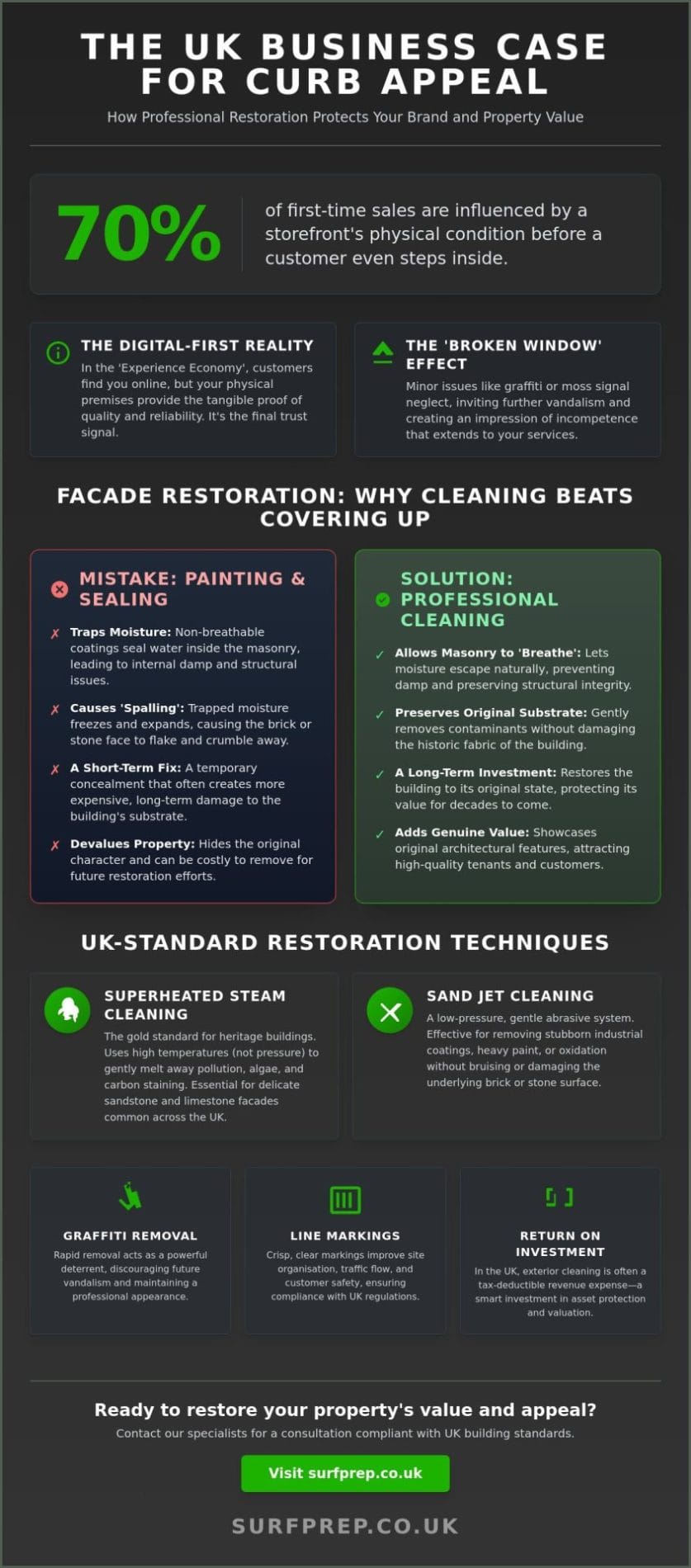
Did you know that 70% of first-time sales are influenced by the physical state of your storefront before a customer even walks through the door? It’s a sobering statistic that highlights why improving business curb appeal is no longer just a minor item on the maintenance list. Whether you’re dealing with weather-beaten brickwork in a damp Northern climate or the constant headache of persistent graffiti, the exterior of your property acts as a silent ambassador for your brand’s standards.
You likely understand that a neglected facade suggests a neglected business, yet the fear of damaging historic stone with overly aggressive cleaning (a common concern for those managing older premises) often leads to costly inaction. This 2026 guide explains how professional restoration and strategic maintenance can transform your first impression whilst protecting your property’s long-term value. We’ll explore how specific techniques, such as superheated steam cleaning and brick restoration, ensure your site remains prestigious, professional, and fully compliant with current UK building standards.
Key Takeaways
- Understand the shift toward the “Experience Economy” and why your physical storefront remains the ultimate trust signal for digital-first customers.
- Discover why cleaning masonry is far more effective than painting over it, allowing stone to breathe and preventing structural issues like damp or spalling.
- Learn how superheated steam cleaning provides a gentle yet thorough solution for restoring heritage facades without the risk of surface damage.
- Explore the strategic finishing touches for improving business curb appeal, including how rapid graffiti removal acts as a deterrent for future vandalism.
- Recognise the impact of crisp, high-visibility line markings on site organisation and customer safety in line with UK regulatory expectations.
Table of Contents
The Strategic Importance of Business Curb Appeal in 2026
Curb appeal is the visual attractiveness of a business premises as viewed from the street. It isn’t just about a fresh coat of paint; it encompasses the condition of your facades, the clarity of your signage, and the overall cleanliness of the surrounding environment. In 2026, the ‘Experience Economy’ has shifted expectations. Whilst customers often find you online first, your physical site provides the tangible proof of your brand’s reliability. A well-maintained exterior is the final handshake that converts a digital lead into a loyal client.
In the UK market, there is a significant rise in ‘industrial chic’, where the focus is on preserving and exposing original brick cleaning and stone cleaning features rather than covering them with modern cladding. For landlords, improving business curb appeal is a direct strategy to reduce ‘void periods’, as high-quality tenants are drawn to buildings that reflect their own professional standards. Retailers, meanwhile, see a direct correlation between a prestigious storefront and increased footfall.
First Impressions and the Psychology of Trust
A neglected facade does more than just look untidy; it creates a sense of ‘perceived incompetence’ in a customer’s mind. If a business appears unable to manage its own property, clients often assume that same lack of care extends to its products or services. This is a commercial application of the ‘Broken Window Theory’. Small, unaddressed issues like minor graffiti or moss growth signal that a property is unmonitored, which frequently invites more significant vandalism and antisocial behaviour.
Measuring the ROI of Exterior Maintenance
The financial argument for restoration is clear when you compare the cost of professional cleaning against total facade replacement. In many cases, restoring the original substrate is far more economical and preserves the building’s historical value. Under UK tax rules, professional exterior cleaning can often be classified as a ‘revenue expense’ for preventative maintenance, making it a tax-deductible cost for many businesses. It’s a sensible way to protect your asset’s valuation whilst managing your annual overheads effectively. For property managers looking to plan these costs strategically, understanding how to budget for cyclical property maintenance can help shift your approach from reactive spending to a structured, long-term reinvestment plan.
Facade Restoration: Why Cleaning Beats Covering Up
When property owners face a tired or stained facade, the immediate instinct is often to "refresh" the building with a coat of masonry paint. This is frequently a costly mistake. Masonry is a porous, living material that must breathe to remain structurally sound. Sealing it with non-breathable coatings traps moisture within the substrate, leading to damp and eventually "spalling," where the face of the brick or stone flakes away. If you are serious about improving business curb appeal, restoration through cleaning is always superior to temporary concealment.
For heritage buildings across the UK, superheated steam cleaning has become the gold standard. This method utilises high temperatures rather than high pressure to melt away decades of carbon staining, algae, and atmospheric pollution. It’s a critical part of the Three Steps To Increasing Interest in a commercial asset, ensuring the structure looks genuinely well-maintained rather than merely patched up. For sandstone and limestone facades common in cities like York and Leeds, this gentle approach is vital to avoid the irreversible damage caused by aggressive pressure washing.
Professional Brick and Stone Cleaning Standards
Adhering to British Standards for masonry cleaning is essential to prevent long-term decay. Using incorrect chemical agents can trigger salt crystallisation or permanent surface etching. For those managing regional portfolios, our guide on professional brick cleaning in Leeds offers specific insights into local architectural requirements. Specialist stone cleaning must always prioritise a pH-neutral approach. This preserves the "quarry sap," a natural protective layer that develops on the stone’s surface over time, which is easily destroyed by the wrong cleaning methodology.
The Role of Sand Jetting in Restoration
Whilst steam is effective for organic matter, some stubborn industrial coatings require a different strategy. Sand jet cleaning provides a low-pressure, gentle abrasive solution for removing heavy paint or oxidation without bruising the underlying material. This process is equally effective for cleaning external wooden beams, restoring the natural timber aesthetic to complement a masonry facade. For heritage properties that also feature exposed internal timbers, understanding how to clean structural timbers in a barn conversion using low-pressure techniques is equally important to avoid saturating ancient oak and inviting decay. If you are considering a restoration project, you can request a site survey to determine which technical approach best suits your property’s specific material composition.
The ‘Finished’ Look: Graffiti, Line Markings, and Industrial Standards
Whilst the building facade serves as the primary focal point, the finer details of a site often dictate the perceived level of professionalism. Industrial units and warehouses frequently suffer from a lack of attention to perimeter aesthetics, yet these elements are vital for improving business curb appeal. A site that features pristine brickwork but is surrounded by faded car park bays and tagged shutters sends a conflicting message to stakeholders. True restoration requires a holistic view of the property, from the height of the gables down to the tarmac.
Graffiti management is a primary concern for many UK businesses, particularly those in urban centres. The most effective deterrent is rapid removal, ideally within a 24 to 48 hour window. This proactive approach signals that the property is actively managed, which discourages repeat offences. Beyond deterrence, the technical method of removal is critical to ensure the building’s long-term health is not compromised by aggressive scrubbing or harsh chemicals. Understanding the full scope of commercial brick cleaning services available to you — from carbon sulphation removal to efflorescence treatment — ensures you select the right specialist for each challenge your facade presents.
Graffiti Removal Without Ghosting
Removing spray paint from porous brickwork is a delicate operation. If done incorrectly, it can leave ‘ghost’ marks or permanent shadows that are almost as unsightly as the original tag. We prioritise methods that lift the pigment from the pores without eroding the substrate. For high-risk areas, applying a sacrificial anti-graffiti coating allows for easier cleaning in the future, whilst permanent coatings offer a robust barrier for modern cladding and non-porous surfaces.
Car Park and Perimeter Maintenance
The state of your car park is a direct reflection of your commitment to safety. Crisp, high-visibility line markings are essential for directing traffic flow and ensuring compliance with UK health and safety regulations. These markings do more than just organise parking; they define pedestrian walkways and loading zones, reducing the risk of accidents on-site. For industrial assets, improving business curb appeal also involves the maintenance of metal gates and shutters. We apply Sa 2.5 standards (near-white metal blast cleaning) to ensure metal surfaces are perfectly prepared for durable protective coatings.
Finally, never overlook the ‘threshold’. Entrances and walkways must be kept free from moss, grease, and other slip hazards. This ensures that the customer’s journey from the car to your door is safe, clean, and professional from the very first step.
Future-Proofing Your Property’s Professional Standards
The shift towards the Experience Economy means your building’s exterior is no longer just a shell; it’s a critical asset that demands technical care. We’ve explored how prioritising restoration over temporary concealment ensures masonry remains healthy, whilst addressing safety details like line markings and graffiti management creates a secure, welcoming environment for your stakeholders. Successfully improving business curb appeal requires a balance of heritage sensitivity and industrial-grade precision.
At Surfprep, we have spent over a decade serving clients across Leeds, York, and the wider Northern region. As specialists in superheated steam technology and rigorous industrial surface preparation, we understand the specific challenges posed by local climates and architectural styles. We pride ourselves on being honest specialists who recommend the right technical solution for the substrate, rather than the easiest fix. If you’re ready to enhance your premises and protect its long-term market value, we’re here to provide dependable, specialist advice tailored to your site’s unique requirements.
Request a professional site survey and curb appeal assessment from Surfprep to begin your property’s transformation. Your building’s best years are still ahead of it.
Frequently Asked Questions
How much does it cost to improve a business’s curb appeal in the UK?
Total project costs depend on the building’s size, the substrate material, and the specific restoration methods required. Factors such as the need for specialist access equipment, like cherry pickers, or the complexity of atmospheric staining will influence the final budget. Whilst it’s a variable expense, improving business curb appeal is often a tax-deductible maintenance cost that protects the asset’s long-term valuation. A structured approach to budgeting for cyclical property maintenance can help you plan these investments across financial years, avoiding the unpredictable costs that come with deferred upkeep.
Does professional brick cleaning damage the mortar joints?
Professional cleaning should not damage mortar joints if the correct equipment and pressure settings are selected. Whilst aggressive, high-pressure washing can scour out lime mortar, superheated steam systems operate at very low pressure to lift dirt without impacting the structural integrity of the pointing. If mortar is already failing, we identify this during the cleaning process so repairs can be organised effectively.
How long does it take to remove graffiti from a commercial building?
Most small to medium graffiti tags on commercial properties can be removed within three to five hours. Larger murals or tags on highly porous surfaces might require a full working day to ensure all ‘ghosting’ or shadows are completely eliminated. We always recommend tackling removal within 48 hours to deter repeat vandals and prevent the paint from bonding too deeply with the masonry.
What is the best way to clean historic stone facades in York or Leeds?
The safest way to clean historic stone in cities like York or Leeds is through superheated steam cleaning. This method respects the delicate nature of local limestone and sandstone by using high temperatures to break down carbon crusts and organic growth. It avoids the surface ‘bruising’ often caused by traditional abrasive methods, ensuring the building’s heritage character and ‘quarry sap’ remain intact.
Can I use a standard pressure washer for commercial building cleaning?
We generally advise against using domestic or standard pressure washers for commercial facades. These units often lack the temperature control needed for effective grease removal and provide too much localised pressure, which can etch stone or force water into the building’s cavity. Professional-grade systems allow for precise adjustments, ensuring the surface is cleaned thoroughly without being structurally compromised.
How often should a business schedule exterior cleaning maintenance?
Scheduling a professional assessment every 12 to 24 months is a sensible benchmark for most UK businesses. Properties located in high-pollution urban centres or near busy main roads may require more frequent attention to prevent atmospheric staining from becoming permanent. Regular maintenance is the most cost-effective strategy for improving business curb appeal and avoiding the need for large-scale, expensive restoration projects in the future.
